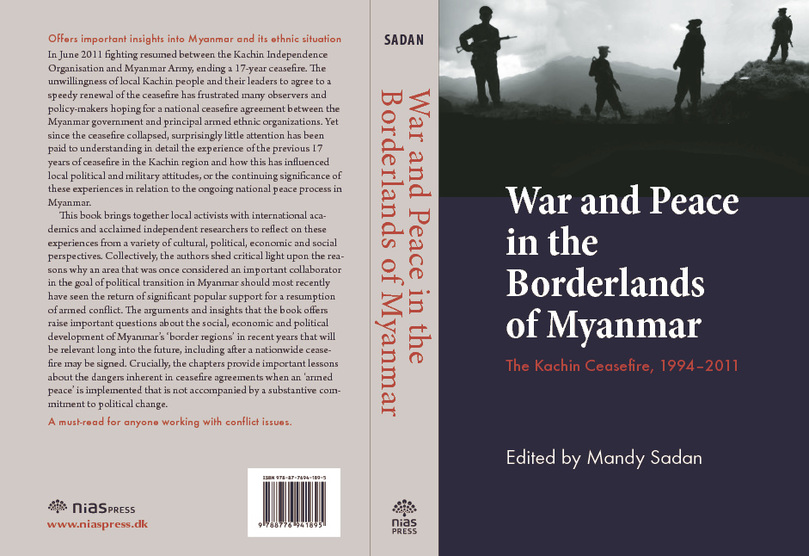
About the bookIn 2011 armed hostilities between the Kachin Independence Organisation and Myanmar Army ended a 17-year ceasefire agreement. Subsequently, local Kachin people and the Kachin political-military leadership have resisted pressure to bow to a speedy renewal of the ceasefire. This has frustrated many observers and policy makers, who hoped to see a national ceasefire agreement signed between the Myanmar government and the country’s principle armed ethnic organisations. Yet since the ceasefire collapsed, surprisingly little attention has been paid to understanding how local people experienced the previous 17 years of ceasefire and how this has influenced local attitudes. Some of these experiences, and their continuing significance in relation to the ongoing national peace process in Myanmar, are discussed in detail in this book.
|
Contents Click on the section headings below to see more.
introduction
longer histories of ceasefire
reflections
political economies of ceasefire
cross-border diplomacy with china
cultural intimacies of kachin nationalism
8. Conspiracy, God’s Plan and National Emergency: Kachin Popular Analyses of the Ceasefire Era and its Resource Grabs - Laur Kiik 9. ‘Before I joined the army I was like a child’: Militarism and Women’s Rights in Kachinland - Jenny Hedström 10. Counting the Days: The Kachin Ceasefire and the Emergence of a New Graphic Medium - Helen Mears local to global experiences
other ceasefires within and beyond myanmar
14. The Continuation of War by Other Means: An Anatomy of the Palaung Ceasefire in Northern Shan State - Patrick Meehan 15. The Karen and the Ceasefire Negotiations: Mistrust, Internal Segmentation and Clinging to Arms - Mikael Gravers 16. Ethnic and Land Conflicts in North East India: Lessons for Myanmar - Reshmi Banerjee 17. The Social Memory of the Mizo Buai: Some Comparisons with the Kachin Conflict - Joy L. K. Pachuau and Mandy Sadan concluding remarks
|
The book brings together local activists, international academics and acclaimed independent researchers to reflect on these experiences from a variety of cultural, political, economic and social perspectives. Collectively, the authors shed critical light upon the reasons why an area that was once considered an important collaborator in the goal of political transition in Myanmar should most recently have seen significant popular support for a resumption of armed conflict. The arguments and insights that the book offers raise important questions about the social, economic and political development of Myanmar’s ‘border regions’ in recent years that will be relevant long into the future, including after a nationwide ceasefire may be signed. Crucially, the chapters provide important lessons about the dangers inherent in ceasefire agreements when an ‘armed peace’ is implemented that is not accompanied by a substantive commitment to political change and about the problems of sustainable war to peace transitions in conflict afflicted areas.
ReadershipReadership: Anyone interested in Myanmar and its struggles with war to peace transitions and developing policies of social inclusion, including NGOs, journalists, policy-makers, academic researchers, graduate and post-graduate students.
|
About the editorMandy Sadan is Reader in the History of South East Asia at SOAS, University of London. She has published much on the history and cultural politics of the Kachin region. Her Being and Becoming Kachin won the inaugural EuroSEAS Book Prize in 2015.
|
Publication detailsSEPTEMBER 2016
NIAS Studies in Asian Topics, 56 500 pp., maps and illustrations, 152 x 228 mm (6” x 9”) Hardback: 978-87-7694-188-8: £65, $90 Paperback: 978-87-7694-189-5: £25, $38 |
To purchaseThe book is available on all major online booksellers. People buying from the US may purchase from University of Hawai'i Press - here.
If you wish to purchase 3+ copies, you may request a discount from NIAS Press. Please click the button below.
|